Racing in Car 2
- 4.1
- Rating
- 100.00M
- Installs
- Free
- Price
 Analysis by App-foxy
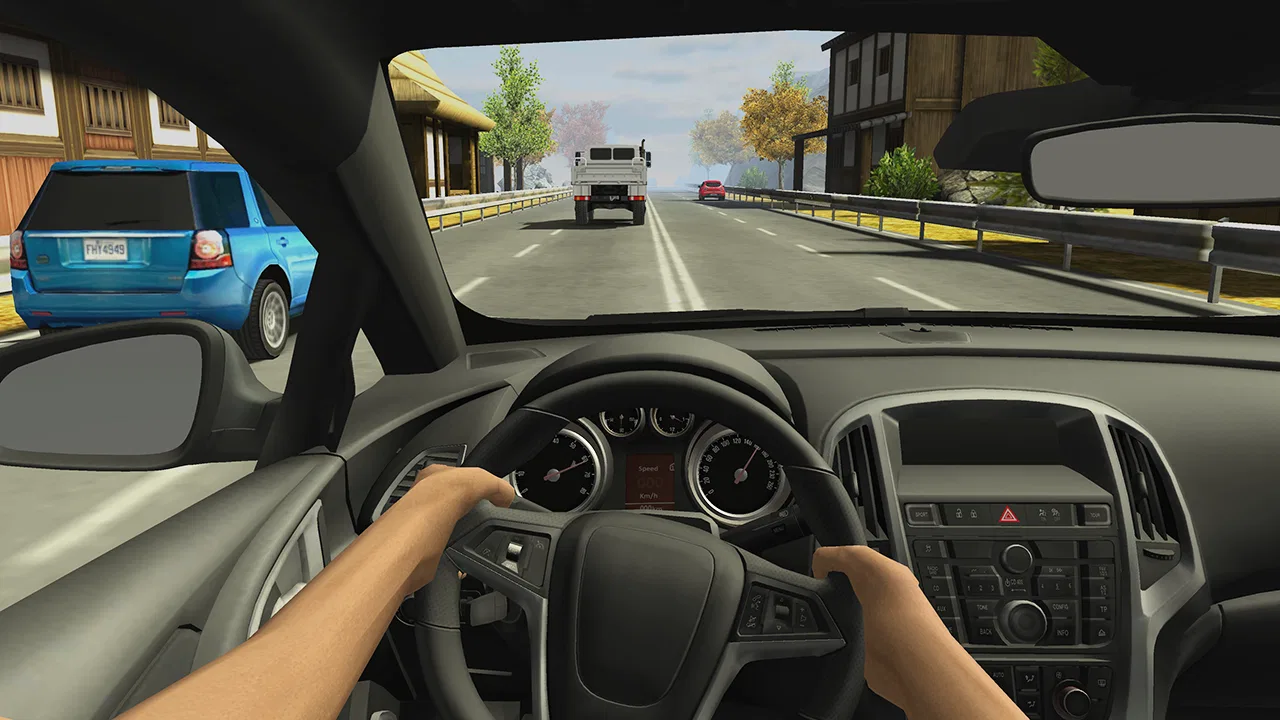
I approached Racing in Car 2 expecting a simple time-killer, and that is exactly where it works best. This free racing game from ckgames puts me behind the wheel from a car-interior viewpoint, then asks me to survive as long as possible while traffic and road positioning demand constant attention. It is not trying to be a full driving simulator or a deep motorsport game. Its appeal comes from the immediate challenge: start a run, find a safe line, take a few risks, and see whether I can extend the drive further than before.
That focused design explains why it has reached more than 100 million installs and earned a 4.1 average from roughly 1 million ratings. Those figures suggest a broad audience, but they do not mean every racing fan will enjoy it equally. I think it suits people who want short, repeatable sessions more than players looking for licensed cars, detailed tuning, structured championships, or realistic racing rules.
How the basic driving loop feels in everyday play
The first useful habit is to treat each attempt as a concentration exercise rather than a conventional race. There is no need to learn a complicated control system before getting started. I can begin quickly, read the road from inside the vehicle, and make small directional decisions as traffic approaches. The interior perspective makes the game feel more immediate than an overhead view, but it also reduces the amount of road I can comfortably process at once.
You May Also Like

 Blood Strike: 2.5 Anniversary
Blood Strike’s Loadouts Turn Every Drop Into a Tactical Gamble
A close look at Blood Strike’s custom loadouts: how fast access to signature weapons reshapes its battle royale rhythm, rewards preparation, and narrows the gap between fights.

 Pandora - Music & Podcasts
Pandora’s Music Is Easy to Start, but Harder to Recover
Pandora’s strength is its low-effort path from a seed to a station. Its weak spot is how much confidence it asks you to place in connection, setup, and quiet recovery.

 8 Ball Pool
 Is Built on Rivalries, Rematches, and Routine
A close look at the rivalries, rematches, shared routines, and unanswered safety questions that turn a quick pool match into a persistent mobile community.

 Samsung Music
’s Quiet Strength Is Playing What You Already Own
Its reach comes less from spectacle than from dependable access to a personal library. That simplicity is both the app’s strongest retention engine and its ceiling.

 AccuWeather: Weather Radar
AccuWeather Review: A Quick, Clear Forecast for Everyday Decisions
For everyday plans, the best forecast is the one you can understand quickly. AccuWeather makes rain timing, radar, and local conditions easy to act on, with a few trade-offs.

 Hill Climb Racing
Why Hill Climb Racing Still Turns Crashes Into One More Run
A tiny car, a bumpy hill and one more upgrade: Hill Climb Racing keeps resurfacing because its simple chaos makes every near-miss feel personal.
More From Our News Desk
View All News


In a normal everyday scenario, this makes the game a good companion for a short break. If I have a few minutes before an appointment, I can play one or two runs without needing to remember a long campaign objective. The downside is that a failed run can feel abrupt, especially when I misjudge a gap that looked safe a moment earlier. The game rewards attention, not passive tapping.
I found it helpful to begin conservatively. New players often focus on passing as many vehicles as possible, but the better starting goal is to understand how much lateral movement is needed for each correction. Large swerves are harder to recover from than calm, early adjustments. Once I stopped reacting at the last second, the road became easier to read and my runs became more consistent.
The interior camera is the defining choice here. It gives ordinary traffic a stronger sense of presence, because vehicles seem to appear within a limited forward view rather than on a fully visible track. That perspective is also the main source of friction. If you prefer seeing your entire car and the surrounding lanes, a third-person racing game will usually provide clearer spatial information. Racing in Car 2 asks you to accept a narrower view as part of the challenge.
The game is rated for Everyone, which matches its accessible presentation and straightforward premise. I would still separate age suitability from difficulty. Younger players can understand the controls quickly, but maintaining a clean run may require patience and repeated practice. The simple presentation does not make the timing forgiving.
The first routine I recommend
For the opening sessions, I would use a repeatable three-step routine. First, watch the traffic flow instead of immediately chasing every opening. Second, make the smallest steering correction that creates space. Third, after a near miss, reset your attention rather than trying to compensate with a dramatic move. This sounds basic, but it prevents the common pattern of one mistake causing a second mistake almost immediately.
Another useful approach is to separate learning from score chasing. During the first few attempts, I focus on how quickly traffic closes and how much room I need to change position. Only after that do I start taking tighter opportunities. This makes progress feel less random, because I am improving a specific decision rather than hoping for a better sequence of vehicles.
There is also a practical reason to play with a stable grip and a clear screen. Because the action is viewed from inside the car, a finger covering part of the display can interfere with the exact area I need to monitor. I prefer holding the device in a way that leaves the forward road unobstructed and using short, deliberate inputs. That small adjustment matters more here than it would in a game with a distant camera.
Settings and presentation choices worth checking
Before settling into longer sessions, I would spend a moment checking the available control and presentation options on the device. The most important question is not whether a setting looks impressive, but whether it helps me read the road. If a visual option makes the scene harder to distinguish or causes the phone to feel less responsive, I would favor clarity and stability over appearance.
This is especially relevant on older hardware. The current version is 1.9 and the game supports Android 7.1 or later, so it can be considered by people using a wide range of devices. That broad compatibility is convenient, but performance can still depend on the individual phone. I would close unnecessary apps, keep the display clean, and avoid judging the game during a moment when the device is already struggling with heat or background activity.
Sound is another setting worth treating as a gameplay tool rather than decoration. I like having enough audio feedback to make the drive feel active, but I would lower it if it distracts from visual concentration or clashes with the environment. For a short commute or waiting-room session, silent play may be more practical. The important point is to choose the setup that lets you notice traffic early and maintain a steady rhythm.
I also recommend checking whether the control arrangement feels natural before attempting ambitious runs. A layout that requires exaggerated thumb movement can make small corrections feel larger than intended. If the game offers a choice that better matches your grip, it is worth testing each option during low-pressure attempts. The goal is not to find a universally best configuration; it is to remove unnecessary movement from your own hands.
One limitation is that this is not the kind of game where settings transform the experience into a fully customizable simulator. The options are useful mainly for comfort, readability, and consistency. Players who expect detailed steering curves, advanced driving assists, or extensive visual tuning may find the setup modest compared with larger racing productions.
Patterns that make runs more reliable
Experienced play is less about constant speed than about anticipating where the next safe space will be. I try to read two vehicles ahead whenever the view allows it. If the nearest car is moving in a way that closes my preferred lane, I begin preparing before the gap disappears. Waiting until the obstacle is directly beside me usually produces a hurried correction.
A second pattern is to avoid changing direction repeatedly without a clear reason. Rapid left-right movement may feel active, but it makes the car harder to place and increases the chance of drifting into traffic. I get better results by choosing a target lane, moving toward it once, and then holding a stable line until the situation changes.
There is a useful trade-off between immediate progress and long-term consistency. Passing through a narrow gap may extend a run and feel satisfying, but a slightly slower route often gives me more time to interpret what comes next. When I am practicing, I choose the safer line. When I am deliberately testing my limits, I take the tighter opening with the understanding that failure is more likely.
For short sessions, I use a simple reset rule: after two rushed decisions, I stop trying to recover the run and treat the next attempt as a fresh start. This prevents frustration from turning into increasingly aggressive steering. It is a small habit, but it makes the game more enjoyable because I am evaluating decisions rather than blaming an unlucky sequence.
Another non-obvious advantage of repeatable habits is that they make the game easier to compare across sessions. I try to play several attempts with the same grip, similar attention level, and the same general risk preference. That gives me a clearer sense of whether I am actually improving. If I change my controls, device position, and strategy at the same time, a better result is difficult to explain.
Where the challenge stops being a strength
The interior camera creates atmosphere, but it also limits information. A player who enjoys precise planning may become frustrated because the road ahead does not offer the same overview as a traditional racing camera. This is not a flaw that better reflexes completely remove. It is a structural trade-off: the game feels more immediate, yet the player has less visual context.
I also would not choose this as my main racing game if I wanted meaningful vehicle progression or a structured competitive ladder. Its compact loop is excellent for repeating a drive, but it does not replace a larger title built around championships, customization, or long-term career goals. Those alternatives are better when the satisfaction comes from building a garage, learning tracks, or comparing detailed performance characteristics.
The free entry point makes it easy to try, while optional in-app purchases range from $1.99 to $19.99 per item. I would approach those purchases carefully. The core appeal is the driving loop, so I would first decide whether the basic experience holds my attention before spending anything. A purchase can make sense for someone who already enjoys the game and wants to support or extend the experience, but it is not something I would treat as necessary for evaluating the game.
Because the title is designed around repeated attempts, repetition can become noticeable. Some players will enjoy chasing a stronger run through small improvements; others will feel that the lack of broader variety makes the experience thin after the novelty fades. I fall between those views. I enjoy it in focused bursts, but I would not play it continuously for long stretches without switching to another game.
Who should install it and who should look elsewhere
I would recommend Racing in Car 2 to someone who wants a quick, accessible 3D endless racing game with a distinctive first-person car view. It is particularly suitable for players who enjoy score improvement, short attempts, and reaction-based decisions. It also works well for people who do not want to learn a complex racing system before having fun.
I would be more cautious about recommending it to simulation fans. If your priority is realistic braking, track strategy, licensed content, detailed vehicle behavior, or multiplayer competition, another racing game will likely be a better fit. The same applies if you dislike repeating similar runs or find interior cameras uncomfortable. The central viewpoint is not a minor visual choice; it shapes nearly every decision.
For families, the Everyone rating makes the game approachable, but I would still encourage younger players to treat it as a patience game rather than a test of speed alone. The most useful lesson is controlled movement. A child who keeps swiping wildly may struggle, while someone who learns to wait and make small adjustments can improve quickly.
The developer, ckgames, has kept the concept easy to understand: open the game, drive, react, and try again. That simplicity is a genuine strength on a phone. It also means the game depends heavily on whether its central loop matches your taste. There is little reason to install it for a large collection of systems; install it because the focused driving perspective sounds appealing.
My final view after settling into the rhythm
Racing in Car 2 is best understood as a compact reflex racer with a strong camera choice, not as a complete motorsport package. I like how quickly it gets to the action and how much difference a calmer driving habit can make. The most rewarding progress comes from reading traffic earlier, steering less dramatically, and learning when a safe gap is more valuable than a flashy pass.
Its limitations are equally clear. The narrow interior view can make situations feel abrupt, the repeated format may lose its charm over time, and players seeking deep racing systems will outgrow it. Those are fair reasons to choose a different game, not reasons to dismiss this one entirely.
For me, the right way to use it is in deliberate bursts: a few attempts during a spare moment, a quick review of what caused the last mistake, and then another run with one specific adjustment. The strongest habit is to pursue consistency before daring passes. If that kind of focused repetition sounds satisfying, this free racing game is worth trying. If you want a career, a garage, or a full track-racing structure, I would point you elsewhere.
FAQs for Racing in Car 2
01What are the main features of Racing in Car 2?
Racing in Car 2 offers a realistic first-person driving experience with intuitive controls. Players can enjoy endless racing in various environments and customize their cars. The game includes multiple camera angles, enhancing the immersive experience. It also supports leaderboards, allowing for competitive play with friends and other players globally.
02Is Racing in Car 2 free to download and play?
Yes, Racing in Car 2 is free to download and play on both Android and iOS platforms. However, it contains in-app purchases that offer additional features or enhancements. Players can enjoy the game without spending money, but certain upgrades or items might require a purchase to unlock.
03What kind of devices are compatible with Racing in Car 2?
Racing in Car 2 is compatible with most modern Android and iOS devices. It requires Android version 4.1 or higher and iOS 9.0 or later. The game is optimized for smartphones and tablets, ensuring smooth gameplay and graphics performance on a wide range of devices.
04Does Racing in Car 2 require an internet connection?
Racing in Car 2 can be played offline, providing a seamless experience without needing an internet connection. However, for features like leaderboards and some in-app purchases, an internet connection will be necessary. Offline play is ideal for users who prefer gaming without data usage.
05How does Racing in Car 2 handle in-game advertisements?
Racing in Car 2 includes advertisements that appear between races or during certain game activities. These ads are a part of the free-to-play model. Players looking to remove ads can often do so by purchasing an ad-free version or buying certain in-game items, enhancing the overall gaming experience.
Pros
- Immersive first-person view enhances realism.
- Smooth and responsive driving controls.
- Varied car selection for diverse experiences.
- Multiple environments for dynamic gameplay.
- Offline mode available for on-the-go play.
Cons
- Limited customization options for cars.
- Repetitive gameplay may feel monotonous.
- Graphics could use more polish.
- Ads can interrupt gameplay frequently.
- Few updates with new content.

Racing in Car 2
Gallery